
10 Train Journeys Worth Booking Your Trip Around

Most "best train journeys" lists are just expensive train journeys lists. This one is ranked differently: scenic payoff relative to what the ticket actually costs, how easy it is to book without calling a travel agent, and whether the journey can anchor a real itinerary instead of being a detour you tack on at the end. The result is a list that has a $23 commuter train at #1, which is either a bold statement or obvious, depending on how much of Norway you've seen.
#10 — Amtrak Coast Starlight (Los Angeles → Seattle, USA)
The best train journey in the US that Americans don't talk about. 35 hours up the California coast and through the Cascades, coach from around $60 if you book early. The stretch south of San Luis Obispo — where the tracks run right alongside the Pacific with nothing between you and the ocean — is the kind of view that makes you realize you've been flying past this for years.
Caveat: Amtrak's on-time performance on this route is famously rough. Build a flexible day at each end or you'll spend your trip refreshing the app.
#9 — Douro Valley Train (Porto → Pinhão, Portugal)
Three hours east of Porto, and view-per-minute, nothing on this list beats it. The train follows the Douro River through terraced vineyards so steep they look engineered by someone who didn't believe in flat ground. Tickets are €14–30 on CP (the regular national rail), no premium tourist train required.
Caveat: The September–October harvest season turns this into a scramble. Book weeks ahead or take the first train of the morning.
#8 — El Chepe Express (Los Mochis → Chihuahua City, Mexico)
The Copper Canyon is four times the size of the Grand Canyon, and the train is the only real way in. The full route covers 650km across the Sierra Madre over two days, with stops at Divisadero or Creel for canyon access. The Chepe Express first-class service is comfortable, air-conditioned, and runs on a reasonably predictable schedule.
Caveat: The Regional train — used by locals, slower, cheaper — is a more interesting ride if you have flexibility. The Chepe Express is fine, but it knows it's a tourist train.
#7 — Flåm Railway (Flåm → Myrdal, Norway)
Twenty kilometers of Norway doing its absolute maximum. The line climbs 863 meters through seven hairpin tunnels cut directly into cliff faces, with a stop at Kjosfossen waterfall where a woman in red sometimes dances on the rocks (it's a thing). Return ticket is around $30–40, and it connects directly with the Bergen Railway at Myrdal.
Caveat: This is one of the most visited attractions in Norway, and the tourist density at peak hours is real. Take the first departure of the day.
#6 — Caledonian Sleeper (London Euston → Fort William, Scotland)
You board in London at night and wake up somewhere in Rannoch Moor. The Fort William branch is the one to book — it splits off at Crianlarich and ends at the base of Ben Nevis, passing through some of the most desolate highland terrain in the UK while you're theoretically asleep. Couchette berths from around £50; private cabins from ~£85–120.
Caveat: The private cabins are small, and the franchise has had service consistency issues since its last changeover. The journey itself always delivers. The hospitality is a coin flip.
#5 — JR Kyushu Pass + Limited Expresses (Japan)
Kyushu has its own shinkansen network and some of the most thoughtfully designed regional trains on earth. A 3-day JR Kyushu Pass (~$120–170 depending on zone) covers not just the bullet trains but the scenic limited expresses — the Yufuin-no-Mori through cedar forests, the Hayato-no-Kaze along the coast — letting you link hot spring towns, castle cities, and fishing villages without touching a road.
Caveat: The pass must be purchased outside Japan. The scenic expresses have reserved seats that sell out; book those at a station on day one.
#4 — Glacier Express (Zermatt → St. Moritz, Switzerland)
The world's most famous slow train is famous for a reason, and the "it's overrated" crowd is wrong. 291 bridges, 91 tunnels, 8 hours from the Matterhorn into the Engadin valley, in panoramic glass coaches that make the whole Alps feel like a diorama you're moving through. Reservations are mandatory on top of your ticket or pass — budget around CHF 140–200 total depending on class.
Caveat: It is slower than taking regular Swiss trains between the same cities. The dining car is expensive. The panoramic windows don't open. These are the correct tradeoffs for what you're getting.
#3 — The Ghan (Adelaide → Darwin, Australia)
The most expensive train on this list, and the one I'll defend hardest. The Ghan costs $600+ for a standard cabin and takes 54 hours crossing the dead center of Australia. There are no towns in the middle. You pass through Alice Springs and Katherine Gorge with guided off-train excursions included — terrain that is genuinely inaccessible otherwise, in a country where "inaccessible" covers a lot of ground.
Caveat: This is a cruise ship on rails: white tablecloths, guided walks, entertainment. If that sounds terrible, skip it. If it sounds like the only sensible way to experience the Australian interior, it is exactly that.
#2 — Bernina Express (Chur → Tirano, Switzerland → Italy)
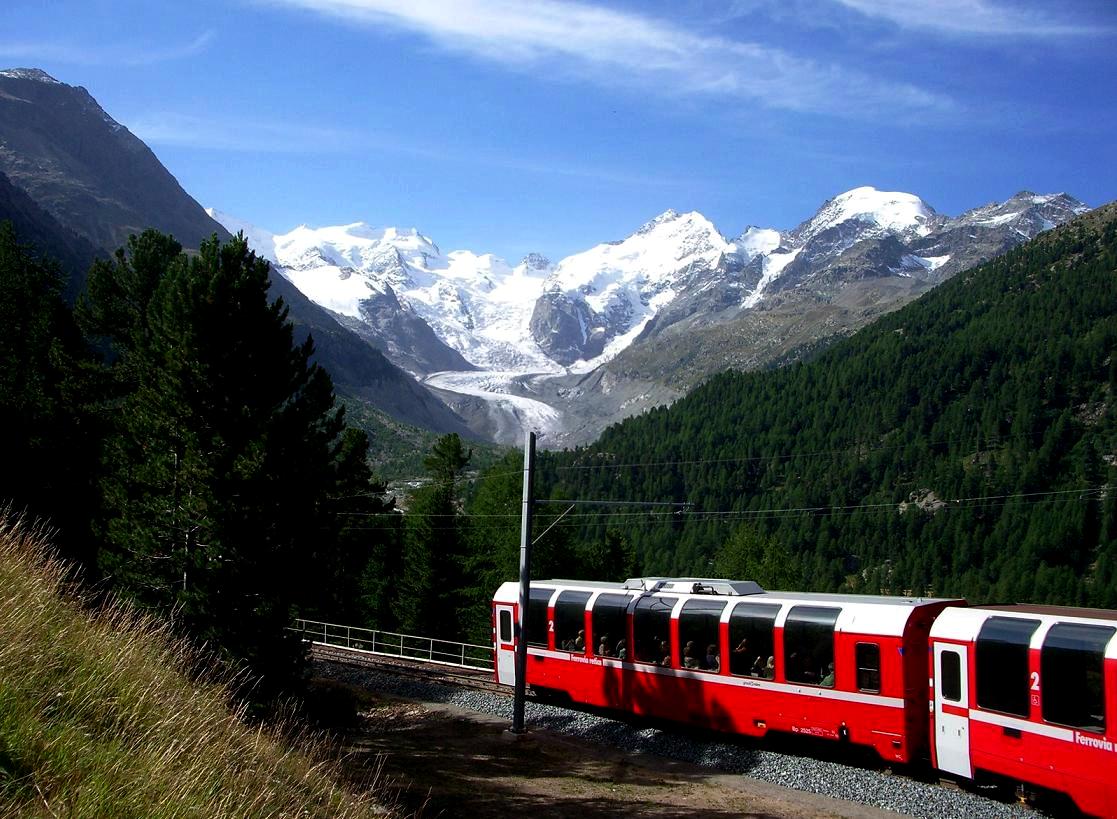
A UNESCO World Heritage railway that goes from Swiss alpine snowfields to Italian palm trees in four hours. The Brusio spiral viaduct — where the train loops a full circle on an open stone arch to lose elevation — is one of those things that's better in person than in every photo you've seen of it. Second-class tickets from ~€48, and the Swiss Travel Pass covers the fare (reservation on top is CHF 40–44).
Caveat: Seat reservations are mandatory and sell out fast in summer. Book the moment your dates are fixed.
#1 — Bergen Railway (Oslo → Bergen, Norway)
A working Norwegian commuter train that casually crosses one of the most dramatic landscapes in Europe. You can book it on vy.no for 249 NOK (~$23) if you're early, or around $50–80 at normal prices. The 471km route reaches 1,237 meters elevation crossing the Hardangervidda plateau — the same terrain used to simulate moon missions for Apollo training — before descending into the fjord country above Bergen. No panoramic glass, no mandatory reservation, no dining car markup. Just the actual Norway, seven hours of it.
Caveat: The most dramatic section is the middle third, around Finse and Myrdal. Don't miss it by booking a sleeper or spending that hour in the café car.
The best journeys are the ones where you'd genuinely be disappointed if the train arrived on time.